Indoor Air Guide
How much CO2 is too much in your home?
Carbon dioxide builds up in every closed room, and most of it is invisible until it's already slowing you down. Here's the full range from fresh to dangerous, what the science says happens at each level, and how fast you can fix it.
Indoor CO2 should stay below 800–1,000 ppm for comfort and mental sharpness. Above roughly 1,000 ppm, decision-making and focus measurably decline. Above 2,000 ppm, most people feel headaches, fatigue, or drowsiness. Levels above 5,000 ppm essentially never occur in a home, that range is an industrial safety limit. If your monitor is climbing past 1,000 ppm, open a window for 5–10 minutes and the number will drop fast.
The air in a closed bedroom or conference room can climb past 1,000 ppm in under an hour with the door shut. You won't smell it or feel it arrive, you'll just notice you're suddenly slower to think.
The 6 levels of indoor CO2
From a well-ventilated room to a level that never happens outside an industrial accident. Ranges below reflect commonly cited indoor air quality guidance from ASHRAE, Harvard T.H. Chan School of Public Health, and OSHA.
That 3pm slump isn't always tiredness.
You close the door for a call, or a video call runs long, and the room quietly climbs past 1,000 ppm. Nobody opens a window mid-meeting.
Past that point, your brain is running on less oxygen exchange than it needs to stay sharp. Focus drops, reactions slow, and decisions get harder, and because CO2 has no smell, you'll blame the coffee, the late night, or "just being tired" before you'd ever blame the air.
You don't feel CO2 building up. But your body reacts to it, hour after hour, in rooms you spend the most time in.
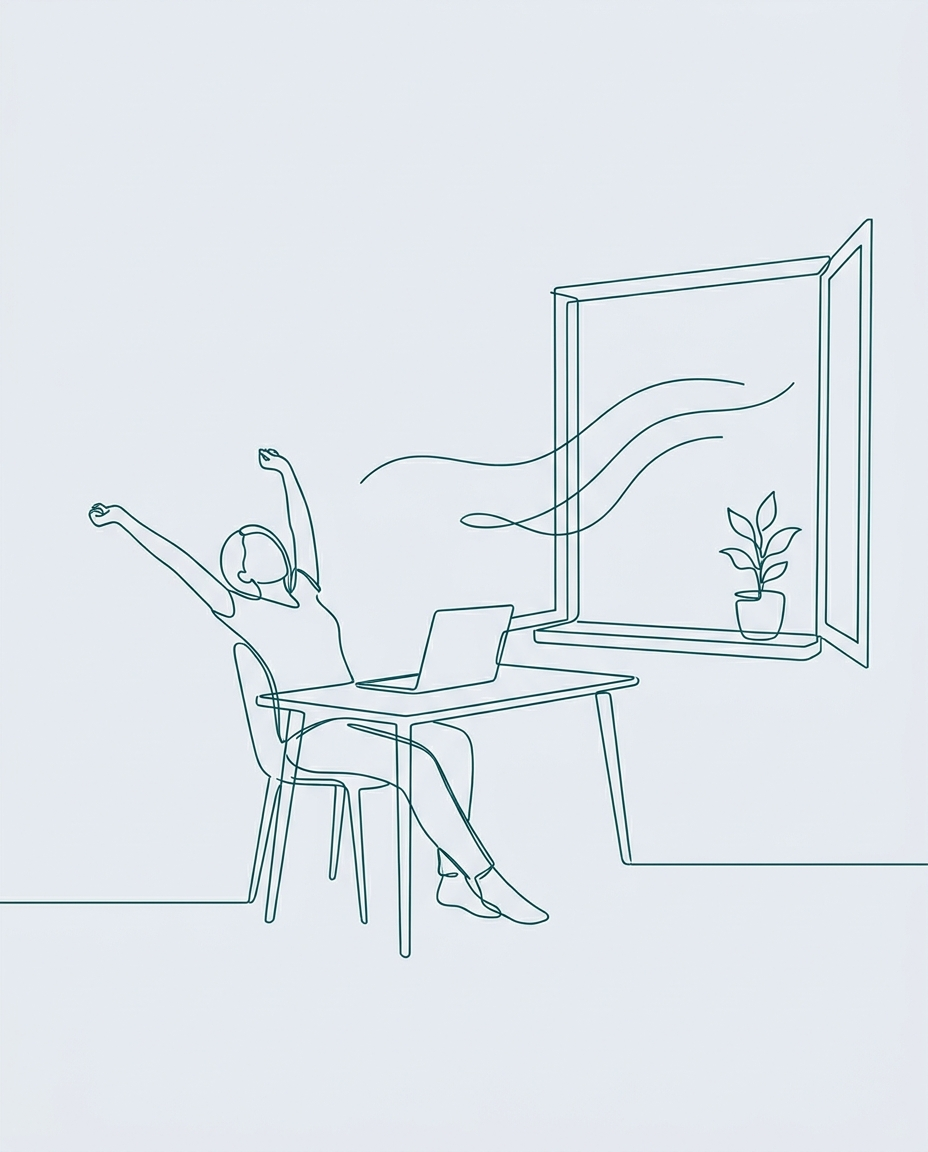
How to lower CO2 in a room, fast
No equipment required for most of these. The goal is simple: get fresh air moving through the space you're in.
The fastest fix, by far
Cross-ventilation for 5–10 minutes resets a stuffy room. Two windows on opposite sides of a space work faster than one.
Crack a door every hour
CO2 climbs fastest in small, occupied rooms with the door shut. A short break with the door open every 45–60 minutes keeps levels in range.
Know before it's a problem
A real-time monitor tells you when a room crosses 1,000 ppm, before the headache or the slump, not after.
BAVAMA doesn't just show you a number.
It tells you what that CO2 reading actually means for the room you're in, and exactly what to do about it, in plain English, not a raw ppm figure.
- 1Live CO2 tracking alongside VOCs, PM2.5, humidity, and temperature, the full picture of a room's air, not one metric in isolation.
- 2Plain-language explanations, so "854 ppm" becomes "focus is starting to drop, open a window."
- 3Timely nudges tuned to your rooms and routines, before a stuffy room becomes an afternoon slump.
CO2 levels, answered
Below 800–1,000 ppm is considered safe and comfortable for sleep and focus. Bedrooms are especially prone to climbing past this range overnight, since doors and windows typically stay closed for 7–8 hours straight.
Levels above 5,000 ppm are classified as an occupational exposure limit for an 8-hour workday, and levels above 40,000 ppm are immediately dangerous to life. Neither range occurs in a normal home from poor ventilation alone, they're industrial-accident thresholds, not household ones. In a home, "high" realistically means anything consistently above 1,500–2,000 ppm.
Yes. Harvard's 2016 CogFx study found measurable declines in decision-making and strategic thinking scores at CO2 levels around 950 ppm compared to 550 ppm, well below what most people would consider a "bad" reading. Fatigue, mild headaches, and slower reaction time are commonly reported starting around 1,000–1,200 ppm.
Open a window for cross-ventilation, this is by far the fastest fix and typically brings a room down within 5–10 minutes. Beyond that: run bathroom and kitchen exhaust fans, avoid keeping doors closed for hours at a time in occupied rooms, and check that HVAC fresh-air intake (the economizer) isn't stuck in recirculation mode.
No, they measure different gases and different risks. A carbon monoxide (CO) detector is a life-safety device that alarms at dangerous CO from combustion appliances or leaks. A CO2 (carbon dioxide) monitor tracks day-to-day ventilation quality; it's about comfort, focus, and long-term air quality, not an emergency alarm. Most homes benefit from having both.
Only marginally. Plants absorb CO2 during photosynthesis, but studies show the effect in a typical room is small compared to opening a window. They're a nice addition, not a substitute for ventilation.
Early access
Be first to breathe easy.
Join the waitlist and we'll let you know the moment BAVAMA is ready to ship, plus founding-member pricing.
You're on the list. We'll be in touch.
Something went wrong. Please try again in a moment.
We'll only email you about launch. No spam, ever.